If you enjoyed my work, I would love if you nominated it for awards: these always help visibility, and it’s been a rough few years in terms of that (thank you not thank you divorce, pandemic and the apparent implosion of twitter, sigh).
Both The Red Scholar’s Wake and Of Charms, Ghosts and Grievances are on the BSFA longlist, and voting for that closes Feb 19th; meanwhile, Of Charms, Ghosts and Grievances is on the Nebula Recommended Reading list. Voting is this way for the BSFA, and this way for the Nebulas.
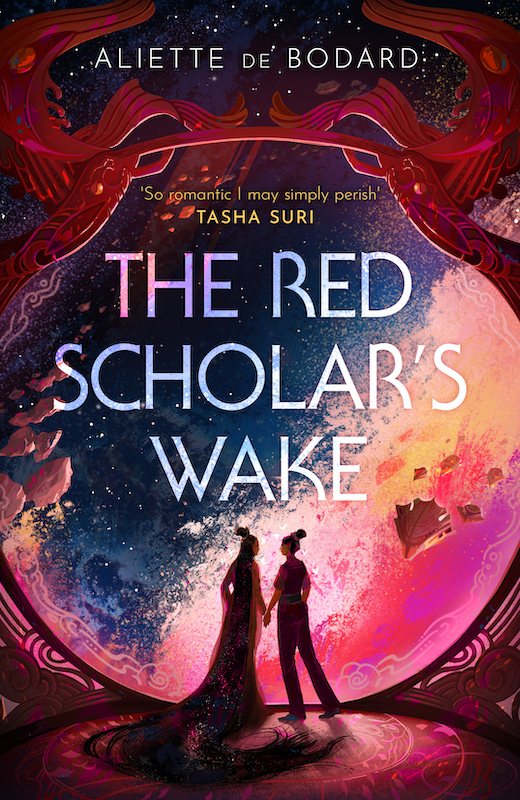
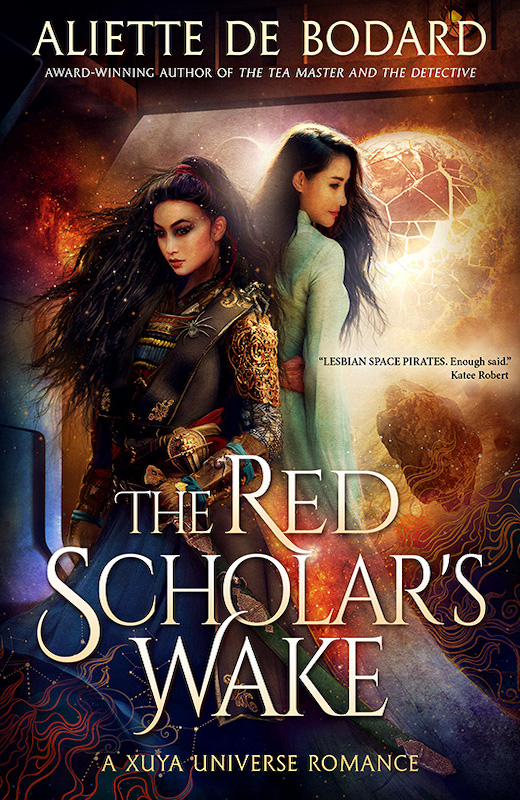
-The artwork by Alyssa Winans (UK cover of The Red Scholar’s Wake) is eligible for Best Artwork, and it’s notably on the BSFA longlist. Would love to see that one recognised because Alyssa has been doing stellar work. See above for the voting link.
–“Elsewhere, Elsewhere”, L. Chan (Giganotosaurus, short story): time magic, timeless love and timeless betrayals.
-The Sunday Morning Transport ed Julian Yap and Fran Wilde is eligible for Best Semiprozine. If you’d like to see what they publish: aside from my own “Sword of Bone, Hall of Thorns“, you can check this Yoon Ha Lee story they published last year which I absolutely loved.
Would also recommend checking out Sara A. Mueller’s The Bone Orchard for Best Novel which is court intrigue + Gothic decadence + whodunit!
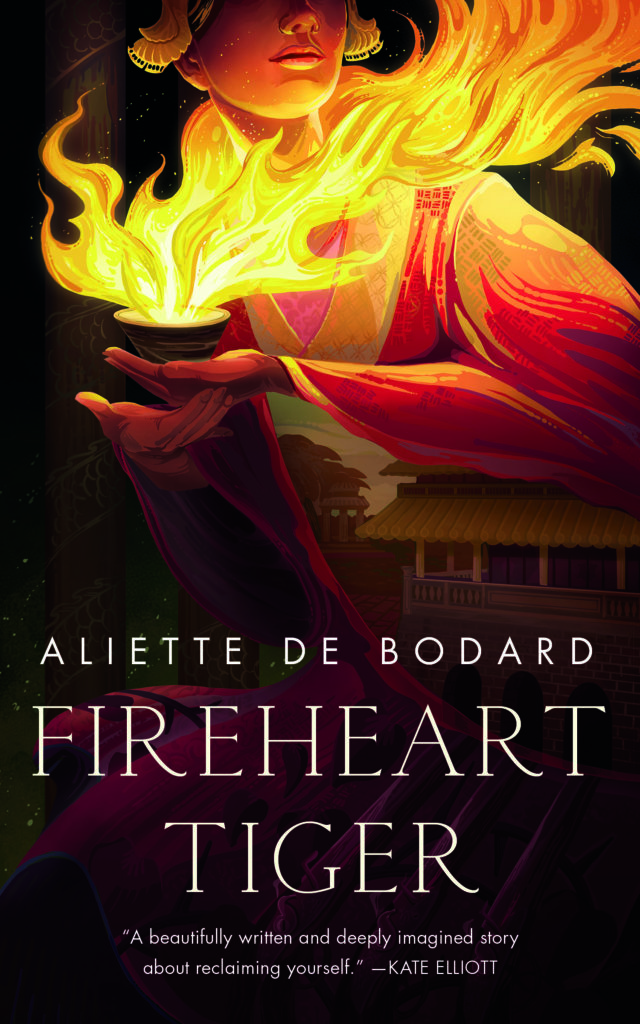
Tor.com has revealed the cover of my upcoming book Fireheart Tiger, an f/f postcolonial The Goblin Emperor meets Howl’s Moving Castle. Look at it, isn’t it amazing?
Cover art by Alyssa Winans
Some small details you might not have noticed:
the dragon on the pillar behind the woman (the flag of the country in the story is the dragon and pearl)
the object catching fire in her hand is a teacup, referring to a story scene
the guns in the lower right-hand corner, both propping up and threatening the palace
the pavilion in the gardens, a crucial story location
the markings on her skin near the flame evoke a tiger’s skin
the large building in her sleeves is Cửa Ngọ Môn, the Noon Gate in the imperial citadel in Huế. The fact that she’s transporting things in her sleeves is a reference to Vietnamese (and Chinese) garments having sleeves large enough to be used as pockets
You’ll be wondering why the title: it refers to a Vietnamese folk tale about how the tiger got his stripes: they’re the marks of a rope when man burnt him with fire, and explains that the resentful tiger now seeks to eat men. I took the fire, the tiger and the idea of imprisonment, and ran with it.
And here’s the official summary
Award-winning author Aliette de Bodard returns with a powerful romantic fantasy that reads like The Goblin Emperor meets Howl’s Moving Castle in a pre-colonial Vietnamese-esque world. Fire burns bright and has a long memory….
Quiet, thoughtful princess Thanh was sent away as a hostage to the powerful faraway country of Ephteria as a child. Now she’s returned to her mother’s imperial court, haunted not only by memories of her first romance, but by worrying magical echoes of a fire that devastated Ephteria’s royal palace.
Thanh’s new role as a diplomat places her once again in the path of her first love, the powerful and magnetic Eldris of Ephteria, who knows exactly what she wants: romance from Thanh and much more from Thanh’s home. Eldris won’t take no for an answer, on either front. But the fire that burned down one palace is tempting Thanh with the possibility of making her own dangerous decisions.
Can Thanh find the freedom to shape her country’s fate—and her own?
The book will be out Feb 9th 2021.
You can preorder now—a small reminder that preorders help books a lot, because they indicate enthusiasm, and that in turn influences visibility and thus the attention given to the book (and many many thanks to everyone who’s already preordered, you rock).
I was exhausted, dealing with health issues and a bunch of kids-related anxiety–and writing had just stopped being fun. I could tell I was flirting with burnout, because I’d had it before in other settings. I could tell I was going to crash and that it wasn’t going to be pretty when it did happen. But also, stopping writing would have been about as easy as stopping to breathe.
So I decided to write something just for me. A book that I’d feel like sinking into for pleasure: a queer retelling of Beauty and the Beast, except in a setting inspired by Vietnamese folklore–drawing from all those stories my mother and grandmother told me, the ones with scholar-magicians and dragons and kỳ lân and rooster spirits, where words had the weight of magic. Something fun and frothy and feelgood.
Obviously I don’t do fun and frothy very well, because I seem to have ended up with a postcolonial, postapocalyptic Beauty and the Beast, where both are women and the Beast is a dragon (because dragons, and because f/f relationships in SFF need more happy endings!), and where spirits and humans alike are struggling to survive in a world ruined by their former masters. And it wasn’t always feelgood to write: in fact, it was downright uncomfortable, because it ended up being such a weighty and personal story, because I drew on so much that meant so much to me. But it was important. It mattered to me. And that helped me claw my way out of the hole. It helped me find joy and meaning in writing again.
It also ended up being a decidedly awkward length (novel-length but too short for fantasy novel publishers). So I had to make a decision: I could stick it in a drawer for the time being, or I could try self-publishing it. I’d self-published books before but never an original, so the idea of doing self-publishing with this seemed like a super scary experience. A bit like putting out a raw bleeding piece of my heart out there without the backing of traditional publishing.
I went the scary way.
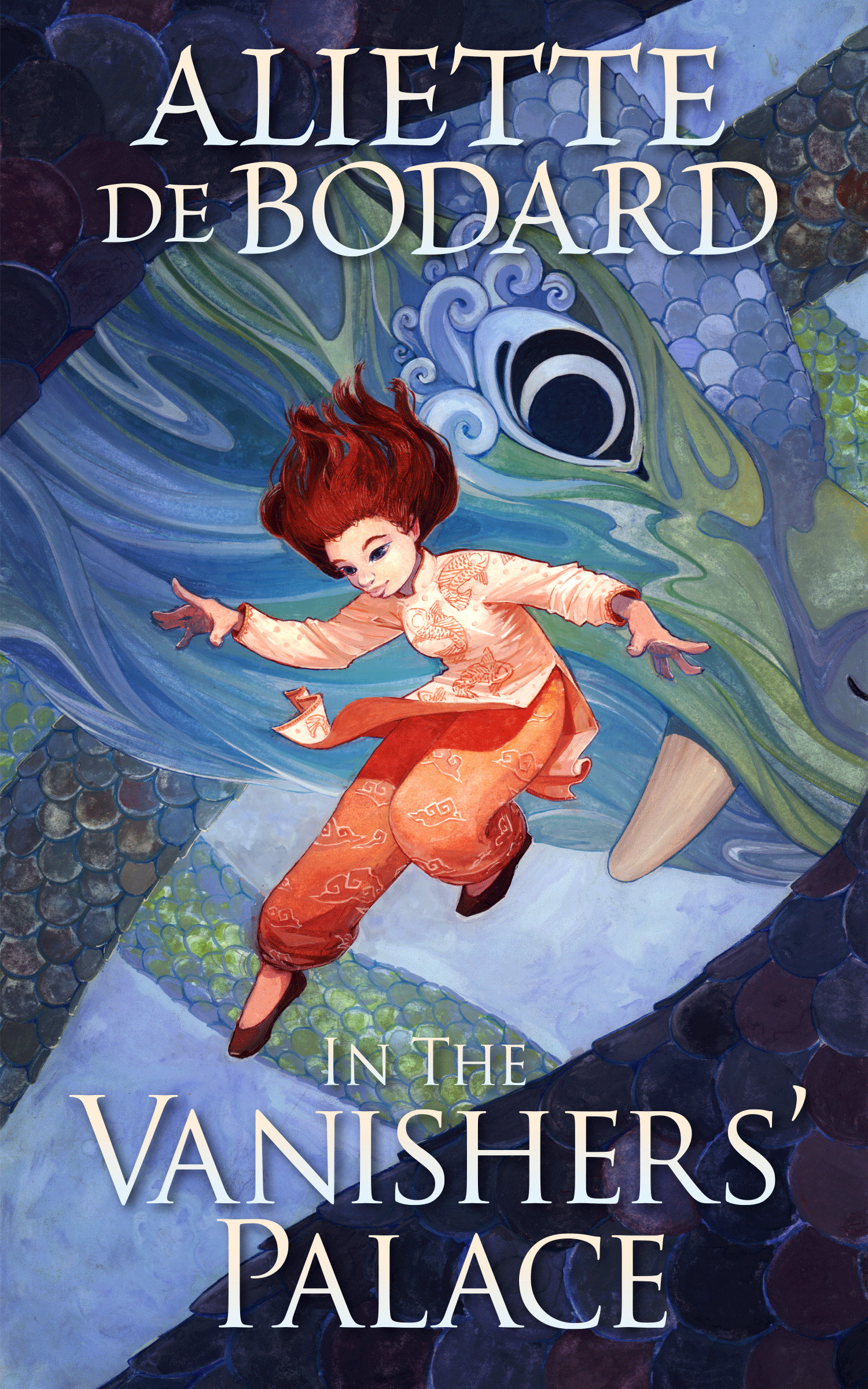
Without further ado I’m very happy to reveal the cover and to open preorders for In the Vanishers’ Palace, which is coming out October 16th from all major retailers. Scroll down for more info!
Publication date: October 16th from JABberwocky ebooks.
(NB: there will be a print edition, it will drop later in October: basically amazon doesn’t let us list a print book for preorder, so we’ll have to manually publish it around mid-October, and then wait about a week for it to go live. Links will be posted when available)
From the award-winning author of the Dominion of the Fallen series comes a dark retelling of Beauty and the Beast.
In a ruined, devastated world, where the earth is poisoned and beings of nightmares roam the land…
A woman, betrayed, terrified, sold into indenture to pay her village’s debts and struggling to survive in a spirit world.
A dragon, among the last of her kind, cold and aloof but desperately trying to make a difference.
When failed scholar Yên is sold to Vu Côn, one of the last dragons walking the earth, she expects to be tortured or killed for Vu Côn’s amusement.
But Vu Côn, it turns out, has a use for Yên: she needs a scholar to tutor her two unruly children. She takes Yên back to her home, a vast, vertiginous palace-prison where every door can lead to death. Vu Côn seems stern and unbending, but as the days pass Yên comes to see her kinder and caring side. She finds herself dangerously attracted to the dragon who is her master and jailer. In the end, Yên will have to decide where her own happiness lies—and whether it will survive the revelation of Vu Côn’s dark, unspeakable secrets…
Advance praise:
“Another stellar offering by Bodard. Her signature intensity is on display in this tale of people (and dragons) struggling to survive in the ruins of an alien conquest. Emotionally complex relationships interweave with richly drawn and deftly nuanced world-building.”
Kate Elliott, Author of the Court of Fives series
“A transformative experience. With dragons.”
Fran Wilde, Hugo and Nebula nominated author of The Bone Universe and The Gemworld series
“Gorgeously atmospheric queer fantasy (…) like Jane Eyre if Rochester was a woman plus a dragon.”
Zen Cho, author of Sorcerer to the Crown and The True Queen
I would love if you preordered this: as I said, this is new and a bit scary for me, and self-publishing obviously means I’m bearing the costs I incurred for making a book (cover art, copyediting, etc.). Thank you so much!
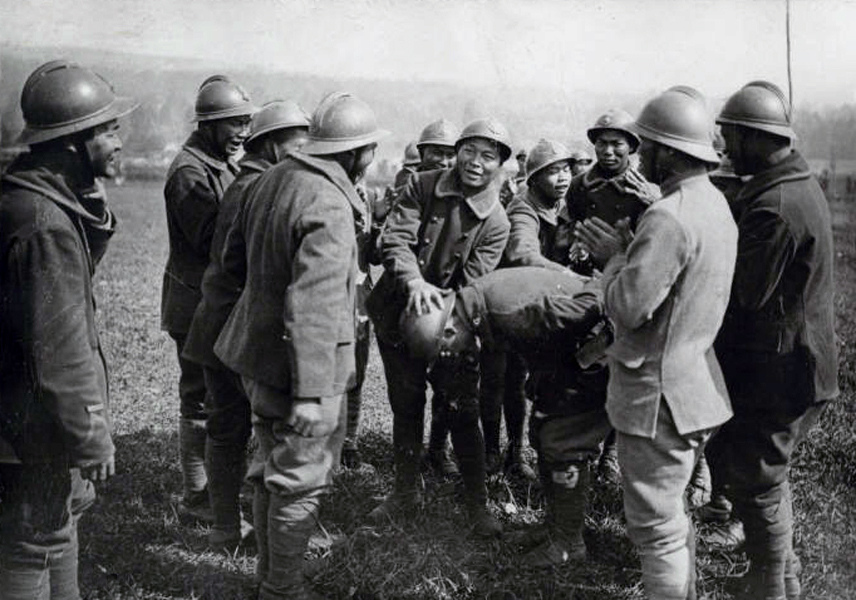
Image: Marne battlefield. Annamites playing in a camp 1914 -18. Photo credit: Manhai on Flickr, reused under a Creative Commons Attribution Generic License.
GoH speech at Stranimondi in Milan, October 10th, 2015
(standard disclaimer: I’m not a historian. I’ll be talking here not about the academic discipline, but about history in the sense of the past and the narrative of the past)
Thank you all for having me here in Milan (and wow, for turning out so numerous 🙂 ). Today I want to talk about history, and the importance of history in Science Fiction and Fantasy.
The first part might seem a little counter intuitive: SF is traditionally a genre that looks towards the future, and history, by definition, looks backwards several decades. But actually, history is a really important thing in genre.
First, history is a source of inspiration. A lot of SFF is retellings of historical events: the obvious one is Guy Gavriel Kay (The Sarantium Tapestry is a retelling of the Nika riots in Justinian I’s reign, to the point where you can guess what will happen if you know the underlying history). Kari Sperring’s The Grass King’s Concubine draws its inspiration from the brutality of the Industrial Revolution, contrasted with a legendary kingdom that is more unmoored in time, but hearkens to older myths and legends. But it’s not only fantasy: some of Yoon Ha Lee’s short stories are based on Korean history; Ann Leckie’s Raadsch Empire (and many intergalactic empires) draws from the Roman Empire (see patron-client relationship, for instance). For the writer, it’s a source of details, events, etc.: most scenarios we can think of have already been played somewhere, somewhen.
But history is also a powerful force in plots: see Isaac Asimov’s psychohistory, and the shaping of mankind’s history (ultimately doomed to failure, for it is the failure modes of science that interest Asimov: the Mule is the one unpredictable factor that deals a serious blow to Hari Seldon’s work). More obviously, history drives a lot of fantasy, in which the key to the plot is often an understanding of history/myth (Brandon Sanderson’s Mistborn trilogy, for instance: the historical excerpts turn out to be key in defeating the Lord Ruler at the end of book 1). History becomes a search for truth, to part layers of obfuscation (sometimes merely lost to time, sometimes to active malice: the origin of the eponymous Game of Fives in Kate Elliott’s Court of Fives, crucial to navigating the underground of the city, has been deliberately obscured by the rulers of the country). Myth and history take on a literal, pressing meaning–it can kill you if you don’t work it out in time.
Knowledge of the past is also a source of power, particularly in post-apocalyptic narratives (Walter M. Miller, Jr.’s Canticle for Leibowitz, Rosemary Kirstein’s Steerswoman, Zelazny’s Lord of Light). In Science Fiction it’s often (obviously) the history of science (because science is primordial), and the recovery of what has been lost, which enable the rise of a new, technology-based society.
I’ve just used truth and power, which are tricky concepts. Both truth and power raise the question of how much you can trust history–how much of it is one truth, and how much of it is written by power. Many cultures have a saying about history being written by the winners, and it sadly holds true. Losers of wars, people dominated by hegemony, don’t get to write their own histories (I’m currently researching the history of colonial Vietnam, and some of the history books written by the French, even today, are… breathtakingly out of touch in presenting a benevolent empire, the loss of which we should mourn for. Yeah. Right).
History is what is passed down, what is told. It is an act of storytelling: the story of how we got there, who our ancestors were, how our relationships with other people, other nations, have been shaped. And, on a smaller scale, we all have family history, family myths. And one thing about stories: they are choices, about which events to present and how to link them into a narrative. Like all stories, history is about erasure. About whose stories don’t get told, about who falls by the wayside.
It’s visible in so many places, but one of the ones that’s struck me recently is the history of genre. As I was writing the first part of this speech, the books I kept coming up with as examples were all written by men. And I’ve seen it happen, again and again online: when asked which books they remember, people cite men (often white men). Ask someone to make a list, and most likely it’ll have 90% men on it (and a token woman, generally Ursula K. Le Guin). Read the history of the genre: most of the people they quote as influential and seminal are men (I read a very depressing history of fantasy yesterday that quoted 90% men, and grouped all the women under “women in genre”). Women and people of colour aren’t remembered, don’t make it into the canon–and yet we’ve always been there!
Obvioysly, in my work, all of these aspects are important. First off, history is a personal inspiration: Obsidian and Blood (Aztec/Mexica history/what if magic was real), Xuya (an alternate history in which the Vietnamese empire is still extant, which draws on multiple sources of Vietnamese myth and history), The House of Shattered Wings (19th Century history of Paris, where magic is powered by Fallen angels and there’s a healthy traffic in angel body parts. Yeah, a little gruesome never hurt anybody).
Also, I am fascinated by history as myth-making, and the truths/lies we tell ourselves: The Weight of a Blessing/Memorials both have different stories of a war, and different people/different generations have different understandings of what the war means. It’s a war with 2.5 sides: the two that actually fought each other, and the 0.5 that supported them with troops–and everyone has a different idea of what the war meant, of whether they won it or not, and what it cost them. The people who weren’t invested see it as a tragedy because waste of life. The people who lost it see it as tragedy, but it’s a different flavours: because emigration and massive uprooting and losses (and I didn’t have space for the third side!).
But lately, I have been most concerned about erasure.
My novel The House of Shattered Wings is set in a post-apocalyptic Paris; it’s my love letter to the city, to the 19th Century novels I loved reading as a child. It merges the backstabbing politics of the beau monde in Alexandre Dumas’s Count of Monte Cristo (the thin veneer of civilisation hiding something as cuththroat and as primal as the bandits they so decry); the heartbreaking poverty and the preoccupation with redemption found in Victor Hugo’s Les Misérables.
It has a lot of references to the history of Paris: it’s set mostly on Ile de la Cité, the historical heart of Paris, and there are gardens and rivers and good food–and people struggling to survive amidst the remnants of a magical war that tore the city apart. Notre-Dame is a major location. The society is a distorted version of the Belle Epoque, with its dresses and swallowtails and elaborate balls, dinners and receptions in salons; its obsession with appearances and having access to the latest fashions (in this case, spells, food, and safety, because this is a post apocalyptic society!) I read 19th Century novels; history books; etiquette books (one particular scene, which involved working out the particulars of putting on and taking off one’s gloves, took me an entire afternoon to research. The etiquette of gloves is hideously complicated!)
But the book is also about the stories that don’t get told.
I was raised in a multicultural household–hearing different languages from French to English to Vietnamese, and as a child of two cultures. As I grew up, I gradually became aware that I was Other (just as, incidentally, Dumas was Other). Exotic. Not conventionally pretty–too small, too slight, too weird (though to be fair, being a nerd probably didn’t help 🙂 ). People like me–like my maternal family–never seem to feature much in those stories beyond the stereotypes of the time period (the Exotic Princess/Slave Haydée in Monte Cristo, the Slave Ali, …)
When I was researching the book, I read up on the indentured colonial workers during the World Wars, and particularly Vietnamese ones. During WW1, they were shipped to the front to fight the Germans, and then shipped back again, because of course colonial workers couldn’t be allowed to remain in France. Everyone had their place–and theirs was to be civilised, far far away in a different land. During WWII, thousands of Vietnamese were “recruited” (press-ganged, in reality) to join the war effort, and put together ammunition. After the war ended–because the country was in ruin, because no one really cared about a bunch of Vietnamese–they remained in their camps, their services sold off as indentured workers. They built bridges and cars, picked up harvests, started rice planting in the marshes. It was seven years after the end of WWII when the last of them was sent home: they had been in the country for 13 years–a lifetime.
And I wondered what it would be like, to be one of those men. To have this burning anger–this growing despair of ever getting home–of wondering if your country will even be there when you do come home, because the war has cut off all communications and no one really knows for sure what’s happening in Asia. To feel, keenly, that you are an outsider–both to your own culture, because of what you went through, but because you’re not French, and the fact that you’re not French is written on your forehead.
Those are the people we don’t talk about. Those are the people who survived in the cracks and the hidden places, away from the centres of power. Some of these men returned home (straight into another war of independence and the messy, messy road of Vietnam becoming a nation). Some of these married, and remained in France–in spite of the fact they weren’t made welcome.
I wanted to write their story. Or, at any rate, part of their story (it being always difficult to do justice to such a complex and long subject in just one book!)
This is why, in The House of Shattered Wings, one of the main characters is Vietnamese–and not only that, but a Vietnamese ex-immortal, a mythical being torn away from his land and struggling to survive in his growing loneliness. It’s why, halfway through the book, you discover that there are other mythical beings, from places that aren’t the Christian, French mythology–and that they have always been there. That they have built their own places, their own imperfect refuges, in the spaces that no one wants.
And, similarly, as I mentioned before, there are lots of Galactic Empires based on the Roman Empire, but few on a Confucian Chinese/Vietnamese model (and those that do often reinforce negative portrayals of an ossified, exotically cruel empire, an image that has nothing to do with the stories I read as a child). It is, in other words, “Othered” China/Vietnam.
(true story: when I was young and read a lot of books, some of them were set in China or Vietnam. They all had this veneer of not very well done outsider narrative, oddly fascinated with things like exotic beauties, cruel and barbaric punishments for the slightest crimes–and magical martial arts/mystical wisdom. I thought they had to be set in Fake China, because the things that they depicted were so completely out of kilter with the ones I was used to that they had to be a fictional land. Now, looking back, I’m not sure whether I ought to laugh or cry).
So I wrote Xuya. It’s my attempt to create a far-future galactic Empire on a different basis, where Confucian cultures are dominant as a matter-of-fact. Where literature is important, scholars are valued, and family always has your back. And where AIs and ships are part of the family, rather than being among themselves, or the property of the military/private traders.
People have commented that it’s not a place where they would choose to live, because the atmosphere feels stiflying to them. To me, it doesn’t, particularly–filial duty and family are important, and they can supersede any individual’s wishes–but of course that’s not the dominant narrative of SF. SF is based on the colonial ethos of America and the Conquest of the West: rugged pioneers striking out for themselves, democracies, capitalism (because that is the only possible society of the future). SF is where families are strictures rather than comfort–gaining independence is the only possible way forward, the narrative we are meant to applaud and praise.
I disagree. I’m not saying it’s a worthless narrative. But it is not the only one. It is not the one I grew up with. Those are not the things that are important to me. There are not the things I want to write about. And, also, history has shown that there are plenty of societies, from the ones that only respect strength and warriors, to the ones where learning and scholarship and important, and warrior is a second fiddle. And I think it’s important to acknowledge this diversity.
It’s important that history is about the multiplicity of people and stories and cultures, and that SFF should be, too.
I’m ten, and voraciously reading–bespectacled, and a head shorter than everyone in class, good at maths and utterly oblivious to the fact that I’m different from everyone else (only later will I work out that the string of people asking me “where do you come from” are comparing me to a class that’s 99.99% white and Catholic, and where the next most diverse person is the lone Ashkenazi Jewish kid, who probably isn’t having a great time either). I take to Science Fiction and Fantasy [1] like a fish to water: people fleeing this world for another; the wonders of space and faraway history where magic is real–where a farmboy can rise to become king; where ordinary people can stop evil in its track; and where science is a force for good, and the future has everyone equal without questions of creed and race.
There are a few… wrong notes, though. I cannot help but notice that Tolkien’s heroes are basically Europeans; and that the Easterlings–yellow-skinned or swarthy–seem to be mostly fighting on the side of evil. I cannot help but notice that most of the cool things in the future seem to be happening to men; and that, for all the talk about appearances not mattering, most women seem to need to be blonde, and young, and beautiful; the dark-haired, yellow-skinned ones mostly seem to be left by the wayside or to be antagonists.
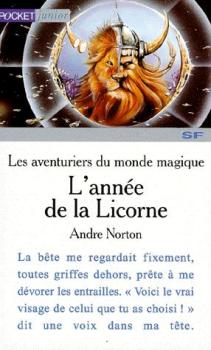
In the midst of this, Andre Norton’s Year of the Unicorn is a breath of fresh air. Gillan is dark-haired and more clever than pretty; and she waltzes through the book on (it seems to me) nothing more than sheer strength of will, and a stubborn refusal to be left behind, or to take anything at face value. When she does get left behind, she fights tooth and claw to find her husband; and make a place for herself in a world that doesn’t want her.
I love Gillan; and I reread the book over and over. It’s not, after all, so hard to see why.
There’s a lot of books in my reading that feature China, or some representation of the Far East–I read them all like I read invented worlds, because the China they depict is so out of touch with my family stories (I won’t say my family stories are all positive! Vietnam has… a complicated relationship with China)–surely they have to be about some kind of fictional China/Far East that doesn’t exist. They speak of martial arts and inscrutable, passive people awaiting to be saved; of some fount of mystical wisdom that awaits the traveller. I think fake!China must be some kind of faraway land invented by writers, because it cannot possibly be the real thing.
I’m in my twenties, and I still love maths, and work to make a living out of it. I discover the American Library in Paris, and discover Le Guin; and it’s like a revelation: SF doesn’t have to be about equations and maths. The SF that speaks to me is about people in the future, about their interactions with technology and with each other; but I’m less interested in whether the technology is feasible. I design feasible technology for a living; and books that strongly focus on this as an element remind me too much of my day job.
As I’m checking out all the Le Guin books ever written from the library, I read The Word for World is Forest. Many, many years later, someone tells me that it’s an allegory of the Vietnam War. I blink, because I know all about the Vietnam War; because it’s shaped my entire childhood; and this isn’t the image that I have. My Vietnam War involves pain and heartache and displacement, and massive family upheavals–not this odd (though good) story about colonists savagely exploiting an alien species, and the natives rising up against them. I realise, then, that there are always several sides to a story; and that not all stories are given the same precedence.
I start writing. I have a master’s degree in science, and general knowledge of physics and electronics; and yet I still do not feel confident that I can write science fiction. I have this image–propagated through books and discussions on forums–that true science fiction is rigorous scientific extrapolation (whether that science is mathematics or anthropology), and I feel I don’t have the credentials for any of this. It will take me many, many years to understand that this set of expectations is stifling and silencing me; and that I’m my own worst enemy, telling myself not to write because I’m not good enough. That I’m far from being the only one in this position or with this experience–that definitions of “proper SF” can end up being a cage for writers and readers alike, an excuse to dismiss everything that doesn’t seem to conform.
I still read books. Most have silent women, or women who use their looks as a weapon. There are no female friendships. There are no mothers, no families. People drink coffee and speak English, and most of them are blond and pale-skinned. When someone who does look or sound familiar appears; when someone seems like they’re going to respect their ancestors and value their families–they’re the aliens. They’re the funny guys with odd customs colonists meet, the ones they try to commerce with or understand or (in the worst cases) subjugate. They’re the invaders that have to be fought back for the sake of civilisation.
And I think “what civilisation?” I wonder how people like me fare, in the future. Or in the re-imagined past of fantasy. Probably not well.
I publish my first stories. I go to cons. I meet other people, offline and online, and start having my first long discussions about genre. I start thinking about what SFF really is. I meet other POCs, other women; learn about feminism; read a lot of essays. I learn that I am not alone; that others have had those same experiences; that others struggled or are struggling, trying to reconcile their love of SFF with that feeling that those universes have passed them by.
And then it hits me: if I want to have a place in those futures, in those reimagined pasts, I’m going to have to be like Gillan. I’m going to have to forge ahead, in the footsteps of those that came before. I will write my own stuff. My universes do not have to be white, or scientific, or sterile and lonely. And, if I don’t write my own experiences, my own cultures–then who is going to write them for me?
I wish I could say it goes without a hitch from there on. That I don’t have the odd conversation (“you write wonderful aliens!” in reference to my future diaspora Vietnamese people); the shouts from various corners telling me I don’t write proper SFF. The nagging doubt that perhaps–just perhaps–they’re right, that there’s no place for me at this table. It’s nonsense, of course. It should be. But thirty years of conditioning are hard to break through; and pushing through boundaries sometimes feel like pushing through tar.
That’s me and SFF, I guess? I feel kind of embarrassed sharing this, but I think it needs to be said–I’m not writing because of politics, or because I want to preach (well, sometimes I do want to write about specific themes that speak to me. But who doesn’t?). At heart, I’m writing my stories: the stories I wanted to read as a child, the adventures in space where I don’t have to feel excluded; the fantasies where you can be small and dark-haired and Asian and still be a hero. At heart, I’m sharing my side of the story, and the things that matter to me–war and exile and devastation, relationships between mother and child and extended families and how these evolve and change in the future. I love SFF. I want to see it thrive and grow and change; and include more and more people from all walks of life. And some of those changes will be uncomfortable. And some of those new stories by new writers won’t be for me or won’t speak to me, and that’s quite fine, because they will speak to someone else.
I hope that things will continue to change. I hope that the taste for this kind of stories grows; that there will be a wider appetite for them as people discover them. I want a future where it’s ok to write the kind of stories I wanted as a child; and where people read them and enjoy them and it becomes a new, significant chunk of the field (and it’s already happening, to some extent, for which I am very grateful). I want the field to reach outwards, step after step after step; until the table is large enough to include all of us on the margins, and we all learn to appreciate and love each other’s experiences and conceptions of the future–for, if SFF isn’t about openness of mind and change, then what is?
[1]It will be many years before I am aware of science fiction as a genre and consciously seek it out; but even before that it makes up the bulk of my reading.
Now that my life is no longer about edits, a few books:
-Zen Cho, Sorcerer to the Crown (ARC obtained from publisher). Zacharias Whyte is the newest sorcerer to the Crown, and he’s got his work cut out for him: he’s black in a society that has no liking for people of colour, suspected of murdering his predecessor and guardian; and to top it all, the magic that England was relying on is steadily draining away. As he travels to Fairyland to determine the cause of the magical penury, Zacharias picks up Prudence, an impoverished gentlewoman who is determined to make her own way in the world–and who has a decidedly peculiar inheritance. Magic, mayhem (and interfering aunties) in a Regency setting: it’s a hilarious book, but also one that pokes sly fun at the social conventions of the time and the place of women and POCs. Sort of a cross between Jonathan Strange & Mr Norrell and PG Wodehouse, with a postcolonial slant. Also, it’s got Malaysian vampires, and they’re awesome.
-Pat Cadigan,Tea from an Empty Cup (book bought). I first read this ten years ago, and it hasn’t lost its power. It’s short and punchy–a double tale of a murder investigation in an immersive artificial reality and a woman looking for her friend and getting caught in some shady dealings involving stolen virtual artefacts, and access to a special level in said artificial reality). I loved the world building (in a dystopic future where Japan has disappeared and the survivors struggle to find a sense of national identity, something that really resonated to me as a second-gen whose maternal country was lost to war for a while); and the artificial reality is amazing–I’m sceptical of SF’s ability to predict the future, but Pat Cadigan was square on, on both the saturation of the AR by ads, and the gaming culture that develops around it, with its accompanied mysticism, its prizing of avatars and things found online and its search for hacks, new levels and new sensations (which reminded me of MMORPGs and Second Life).
(a few minor quibbles: I wasn’t quite sold on the idea of racial memory, or on the idea you could tell someone’s racial mark-up just by looking at them–as a diasporan, the elevated mysticism and mythology that develops around the lost land of Japan feels very accurate, though sometimes a little too forced and forceful for my personal taste. And sometimes the world building rang a little hollow–I wasn’t sure what Yuki did for a living or how she was able to drop everything to follow Joy Flower. But that’s very much a function of this being a short and to-the-point novel).
-Nghia M Vo, Legends of Vietnam: An Analysis and Retelling of 88 Tales (book bought): I’m really conflicted about this book. On the one hand, it’s a reasonably good book of fairytales and Vietnamese folklore, with legends from the North, the South and some (all too few) from ethnic minorities. It provides context, both cultural and historical (and it’s got all the proper diacritics, which is awesome for following up on stuff), and there are lots of tales and tidbits that I’ve heard but not seen elsewhere, so I think it’s fair to call it the most complete compilation I’ve seen yet. On the other hand… the commentary sometimes grates. There’s the odd swipe at passive Vietnamese, incapable of banding together or of understanding progress, unlike Western nations (which is just wtf); and a lot of sallies against the Northerners (and I know there was a war; I know unforgivable things were done and I’m not minimising the pain people went through; heck, I live in its shadow. But I really don’t think a book of fairy tales is the place for this kind of stuff). Of note, there’s a bunch of tales in the post-war years, but I can’t comment on these because I found them triggering, and had to skip this section.
-Kari Sperring, The Grass King’s Concubine(book bought) This is a book with several narrative strands: one in the present, where Aude, born to wealth, runs away and seeks to understand where her family’s fortune came from; and one in the past, where a man called Marcellan enters the Rice Palace, domain of the Grass King, the mythical being who embodies the earth and the harvest. In the present, Aude gets kidnapped by the Grass King’s bannermen, and taken to a deserted, devastated Rice Palace, where she is told she must fix what her ancestors broke…
This is slow, intimate and quite wonderful. I love the contrast between the Brass and Silver Cities and their endless hunger for wealth (and one of Kari’s strengths, I think–in addition to lush prose–is that she nails social class, social oppression and the way the progress of the Industrial Revolution was built on the misery of the many), and the Rice Palace and its fairytale logic; and the driving mystery of what exactly happened in the past is very well done (and going to an unexpected conclusion). It seems at first that the two halves (the Industrial Revolution cities and the Rice Palace) belong to two wildly different books, but on finishing the book you realise that the unifying theme is the devastation of greed and hunger for power–and that, in that respect, the present is not so different from the past–it’s a very clever and subtle juxtaposition, and it works all the better for never being outright said.
I have a couple quibbles, the first is that you should avoid reading the cover copy before you start the book, because it has the worst spoilers I’ve seen in quite a while; the second is that the ending feels a teensy bit rushed–and by far the most major one is that this begs for a sequel, and there is none yet! (I have a plan which involves pestering Kari until she gives in ^^).
Once upon a time, in a far, far away galaxy, I began working on this odd little project. It had started as a urban fantasy set in 21st century Paris, where families of magicians held the reins of power in every domain from banking to building. Then I couldn’t make it work, because the worldbuilding wasn’t clicking with me. I wrote perhaps three chapters of it before it became painfully clear that my heart wasn’t in it.
So I nuked Paris.
Well, sort of. I made up a Great Magicians’ War, comparable in scale to WWI: a war that devastated Paris, making Notre-Dame an empty shell, the Seine black with ashes and dust; and the gardens and beautiful parks into fields of rubble. I set the action back several decades, to have a technology level equivalent to the Belle Époque with magic; and I added Fallen angels, whose breath and bones and flesh are the living source of magic; and whose power forms the backbone for a network of quasi-feudal Houses who rule over the wreck of Paris. And, hum, because it’s me, I added an extant colonial empire, a press-ganged, angry Vietnamese boy who’s more than he seems; Lucifer Morningstar (because you can’t have a story about Fallen angels without Morningstar); and entirely too many dead bodies.
In short, I mashed so many things together that it started looking a bit like the Frankenstein monster right before the lightning hit; but my fabulous agency (John Berlyne and his partner John Wordsworth) didn’t blink (at least, not too much!), and duly sent out my little novel, called The House of Shattered Wings. And lo and behold, the awesome Gillian Redfearn of Gollancz picked it up, along with a sequel. To say that I’m thrilled is an understatement: Gollancz is a superb publisher, and their list includes many friends of mine—I can’t wait to see where this goes.
Official synopsis:
In HOUSE OF SHATTERED WINGS, Paris’s streets are lined with haunted ruins, Notre-Dame is a burnt-out shell and the Seine runs black with ashes and rubble. De Bodard’s rich storytelling brings three different voices together: a naive but powerful Fallen angel, an alchemist with a self-destructive addiction, and a young man wielding spells from the Far East.
Release is slated for August 2015. You can pre-order here at amazon or Waterstones if you want a shiny hardcover (I’ll work out other vendors later, promise. I don’t need to tell you how crucial pre-orders are to a book’s success–so get in early, get in strong, and make this a big big success). If you don’t feel like pre-ordering right now, no worries. There’ll be plenty of opportunities :p
ETA: and here‘s a fresh new page devoted to the book, with more detailed copy.
More on the book when I have normal (ha! Who am I kidding) non-zero energy levels.
(picture credits: Kirkstall Abbey by Rick Harrison. Used under a Creative Commons Attribution-NonCommercial-ShareAlike 2.0 Generic License).
My colonial Indochina story “The Moon over Red Trees” is up at Beneath Ceaseless Skies: you can read it here. This is something of a departure for me: I haven’t done historical fantasy in a while, especially not in that time period. Would be very happy to hear what you think.
I’ve updated the story page of “The Moon Over Red Trees” with copious author notes: go here, though they’re spoiler-filled and better read after the story.
Briefly emerging from my winter sleep, aka “full-time care of the snakelet while holding a day job and writing a novel/novella ™”, to point out a couple of places I’ve been this week:
-Roundtable on fantastical creatures at The Book Smugglers, with Silvia Moreno-Garcia, Shveta Thakrar, Octavia Cade, Marie Brennan, Whiti Hereaka, Rochita Loenen-Ruiz, E.C. Myers, Benjanun Sriduangkaew, Bogi Takács, Joyce Chng and me: part 1, part 2. I talk dragons (rồng) and turtles (rủa) in myths!
-My Beneath Ceaseless Skies Aztec steampunk story “Memories in Bronze, Feathers and Blood” is re-released as part of the Audio Vault, with a new introduction by me on the genesis and worldbuilding of the story: listen here.
-Still at Beneath Ceaseless Skies, the new issue, available at Weightless Books and Amazon, contains my colonial Indochina fantasy “The Moon over Red Trees”, as well as fiction by Richard Parks, K.J Parker (OMG I’m sharing a TOC with K.J. Parker!), and Gwendolyn Clare
I’ve sold it to Subterranean Online for a future issue. Many thanks to Yanni Kuznia for the invitation, and to Gareth L Powell and Rochita Loenen-Ruiz for the feedback (extra thanks to Rochita for putting up with my total absence of a brain). It’s set in the Xuya continuity, some time after On a Red Station, Drifting (and even has a returning minor character from that novel). Features mindships (of course), the Four Saintly Beasts, and the Vietnamese concept of “duyên” (wonderfully economical concept, a headache to translate into English though!). Also, I actually wrote this while feeding the snakelet nonstop, which is probably worth a zillion achievement points all by itself…