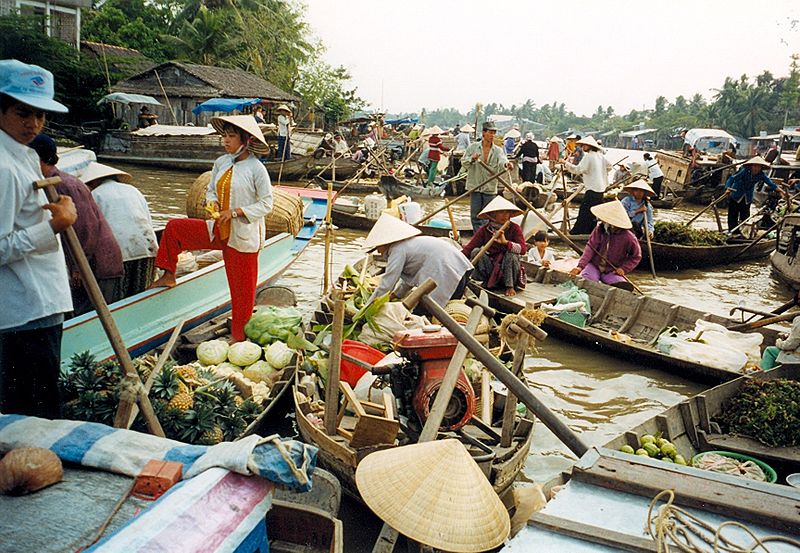
Return of the killer Vietnamese

Tags: blog, , , No Comments »

So, just switched my language tapes from the course Mom and I are reading from, to the older Foreign Service Institute ones–which have the huge advantage of actually having a (60ies pre-war) Southern accent. And I finally figured out why I had so much problems with terminal consonants (which always have Mom shake her head at me). I’d worked out a while ago that terminal consonants in the Southern accent were not pronounced as you’d expect, ie by analogy with the same consonants in non-terminal positions (which is the case in Northern accent, incidentally). However, every time I opened my mouth, I seemed to come up with a different version of fail.

So, the good point: there’s a logic. The bad point: most pronunciations appear to have very little to do with what I expect as a French/English speaker. And they depend on the vowel immediately preceding the consonant, which explains why I could never work out a consistent system (I naively expected that one consonant=>one pronunciation).

To give you a couple of examples:
-”-p” (like in “tập”: volume, tome, episode): mostly sensible, pronounced like a “p”
-”-ch” (like in “thích”: love, like): always pronounced “t”
-”-t” (like “tết”: New Year, “một”: one, “cắt”: cut) much less intuitive. If after “i” or “ê”, pronounced “t” (except for the very particular diphtong “iết”, which is pronounced sort of like “beerc”). If after “ô” or “u”, pronounced sort of halfway between “p” and “k”. If after any vowel not previously mentioned (or after the aforementioned “iế”), then pronounce it like a throaty “k”.

And then you wonder why I could never work out terminal consonants… (and I have a suspicion this is an simplification to help language learners get it more or less right…)

*headdesk*

Your hemi-semi-weekly Vietnamese proverb

Tags: blog, , , , 5 Comments »

“Có công mài sắt, có ngày nên kim”: “If you work hard enough at sharpening iron, one day you’ll have a needle” (literally “Put effort [into] sharpen[ing] iron, have one day in the end [a] needle”). Basically, insofar as I can tell, the closest equivalent would be that nothing is obtained without hard work. Again, I’m pretty sure of my translation, a lot less sure about my reading of the proverb.

Progress continues apace; I’m turning to vocabulary words that might actually be useful out there, namely: “nhà băng” (bank), “thông hành” (passport), and “khách sạn” (hotel). My vocabulary continues to be overwhelmingly focused on food, though: at the very least, menu-reading isn’t going to be a problem (nor is ordering, at least if they don’t answer back…).

Had last lesson before leaving; if nothing else, it confirmed that boy, I need to work on my neutral and short-descending accent (and my diphtongs and my “th”, and so on, and so forth). Should be fun…

That’s it from me. Don’t know how much internet I’m going to have over there (it’s not that there isn’t any, but rather that we might be busy). See you in two weeks?

Your hemi-semi-weekly Vietnamese proverb

Tags: blog, , , 2 Comments »

“Cái nết đánh chết cái dẹp.”: “Good behaviour trumps [lit. "beat to death"; I'm assuming it means "utterly triumphs over" rather than "bludgeon to death"] beauty”. Again, could be wrong; this was me with a dictionary and the vocab I learnt so far (actually, literally, I think it means something like “the good behaviour thing beats to death the beautiful thing”, but obviously it’s a little awkward that way).

Meaning pretty much self-evident.

Also, I managed to say the equivalent of “I speak a little Vietnamese, here are the words I know” over twitter and not get laughed at! (it did pose a funny set of problems, because the pronoun “I” depends on the perceived age of your interlocutor, and the pronoun “you” depends on their age and gender. Now guess what you do when you have neither? Flounder, quite obviously… [1]) It’s amusing how the internet generates new sorts of language problems that you never really think about…

Words learnt: 150 (plus stuff I don’t consciously learn, such as food and funky pronouns. See “mình”, the pronoun used between husband and wife, which also has the meaning of “body”). It has occurred to me that part of the problem with this %%% language is that it’s the first language I learnt that is so distant from French: English and Spanish both have a striking number of similarities with French, especially for newspaper speak. For instance, I can understand a sentence like “The Prime Minister of Great Britain declared that the crisis in the eurozone…” even if I didn’t know all the words, because so many of them are similar to French. Now, in Vietnamese, “prime minister” is “thủ thống”, “declare” is “tuyên bố”–and let’s not even get into “eurozone”… You do have surprise words: “súp” is “soup”, “phó mát” is “cheese” (aka “fromage”), “nhà ga” is “station” (aka “gare”. “nhà” is just “house, building”); but far fewer you’d have in Spanish (where I can fake understanding of a lot of words, because hey, Romance languages!). I have to reach for the dictionary every two words on a good day (and even more than that, because the grammar is so different from French and the whole act of translating really requires firing neurons in the right mindset. Kind of reminds me of Ancient Greek, actually. In worse…


[1]Not totally true. There is a neutral and uncomfy pronoun “I”, “tôi”, which I can use for those cases. And, if the speaker is around my age bracket, “bạn” (friend), has the advantage of being genderless (but it’ll piss off someone much older than me really fast). Bit awkward, but hey.

Progress, and travel plans

Tags: blog, , , , 5 Comments »

Hue Imperial City

So… My understanding of written Vietnamese is definitely improving (in the new lesson, I understood what they were saying to each other with just a few well-placed explanations from Mom); my pronunciation still kind of sucks. Let’s not speak of my spelling, which has got Mom going into fits semi-regularly. She’ll say a word, and I’ll write it down, and know that I got it wrong. The “this pronunciation translates to this accent” isn’t happening so well right now, whereas the “this accent translates into this pronunciation” is a little bit better ingrained. I can repeat fairly accurately; I can’t really manage unprompted unless it’s very simple things (“hello”, “thank you”, “please give me a bowl of phở” *g*). Not surprising: I’ve always been more visual than auditive (yup, writer. Why do you ask?) As I was saying to Mom, the main thing where I’ve improved is that I’m reasonably sure that I can read and understand a Vietnamese menu with close to no help (barring the odd unknown vegetable, though Vietnamese is very kind by providing classifiers: “rau” for herbs, “cây” for leafy things, “trái” for fruit, “củ” for tubers…). I *might* possibly be able to order, if I steel myself not to follow the path of least resistance and speak English.

Why does this matter, you ask? Weeelll… The first two weeks of February, the H and I will be traipsing through Vietnam. Specifically, through Huể (high time I visited the imperial capital, or what’s left of it), Hội An, Sài Gòn, and the South around Sài Gòn (yes, I know it’s HCMV now. Never quite got used to it). I’m down to two people warning me the accents of the Centre are horrible–that I should be more than adequately equipped to handle Southerners, might possibly manage to understand Northerners, but that the Centre is a law onto itself. Given that I can barely make myself understood by Southerners, I can’t help but think that the Huể/Hội An section of the trip is going to be so much fun… (Sài Gòn will be better, both because, hey, Southerners, and also because Grandma/the uncles will be around)

Three more lessons to go before we leave. Ouch.

Your semi-hemi weekly Vietnamese proverb

Tags: blog, , , No Comments »

“con rồng, cháu tiên”: “child of dragons, grandchild of immortals”.
This one refers to an old tale: according to legend, the Vietnamese people are descended from the union of the dragon Lạc Long Quân and the immortal Âu Cơ: they had a hundred children together, but because they were so different (he was a dragon from the deep seas, she was an immortal and only felt at home in the mountains), they ended up separating. Lạc Long Quân, summoned home by his mother, took half the children and went towards the sea; and Âu Cơ took the other half into the mountains. This was the origin of the Vietnamese people.

I am currently learning preposition and interrogative words (the words that you tack on the end of a sentence to signal that it’s a question. Yup, it’s a tonal language, which means that raising your voice at the end of a sentence just results in your mangling the last words by giving it a rising accent…). Not exactly fun, but necessary.

Your hemi-semi weekly Vietnamese proverb

Tags: blog, fiction, , , , 2 Comments »

“báo chết để da, người ta chết để tiếng”
A panther when dead leaves behind a skin; a man [lit. people] when dead leaves behind a name/reputation/words.

Pretty. Also, I learnt lots of new words :)

I’d like to think my vocabulary is improving, but 3 words a day isn’t very efficient to build up vocab (mind you, with me putting in about 15-30 min per day, I don’t reckon I can get more efficient than this). I got myself an Oxford picture dictionary English/Vietnamese; the unfortunate bit being that it’s for Vietnamese immigrants to Western countries, and therefore it uses English concepts: it’s OK for most everyday words, but it lacks Vietnamese syntax, and the concepts that are different just aren’t explained: the various kinds of uncles just get lumped under the same English word (yes, there are four words to describe uncles in Vietnamese: cậu, bác, chú, dượng respectively brother of mother, elder brother of father, younger brother of father, and any uncles that have married into the family rather than being linked to it by blood). So not quite what I want to be studying intensively…

In other news, work has started again on the novella that wouldn’t die (complete redraft), so I’m going to be scarce this week. And, hum, the week after (which is Christmas anyway).

Sort of progress

Tags: blog, , , No Comments »

Hum, I think I’ve sort of made progress in Vietnamese–I can sort of pronounce stuff (after 15 minutes of putting myself back in the proper mood). Now, if I could actually separate words properly instead of pronouncing them randomly (you know, like saying “the yel-low cat da-shes a-cross the lawn” in one long horrible run-on sentence makes sure that virtually no one can understand you? I can do that *so* well).
Also, I need to stop confusing “d” and “đ” (one is a “y” or “z” depending on whether you’re Southern or Northern, the other is a “d”), and “t” and “th” (hard. Sort of the difference between a hard French “t” and a soft “th” like “think”, but it doesn’t always work).

Arg. Need to practise more.

In other news, “to eat” in Vietnamese is naturally “eat rice” (ăn cơm), and “to cook” is “to make rice” (làm cơm). Yeah, figures.

Tomorrow, I will edit the crap out of one short story. And possibly do a green mango salad.

Why I can’t translate my own books

Tags: blog, , , , , 2 Comments »

So, tonight I was rereading the French translation of Harbinger and finishing up with a few troublesome notes. Here’s a sample scene from that endeavour: I’m sitting in the sofa with the French translation on my knees, and going through my own notes. From time to time, I’ll ask a question to my husband that goes something like this:

Me: “Here, listen to this. Do you think there’s something wrong with it?”
The H, frowning: “Er. No. Quite honestly no. It’s just you trying to apply English grammar to the text.”
Me: “What about this? Don’t you think it’s too modern for the time period?”
The H, still frowning: “Hum… Probably.”
Me: “What would you replace it with? I’m coming up blank…”
[The H rolls his eyes upwards, but agrees to brainstorm suggestions with me for a bit]

And this, right here, is why I would make such a bad translator from English to French…

(let me reassure you that it’s nowhere as catastrophic as it seems, and that I manage most of the edits on my own, especially the translations of technical terms my wonderful translator–Laurent Philibert-Caillat–wasn’t entirely sure on. But about a fourth to a fifth of my edits have to go through my husband, to make sure that I’m not inserting random anglicisms into the text…)

In other news, the H forcibly put me in front of my computer Saturday morning, and insisted that I write something and stop moping on the internet. Whad’ya know, it actually worked. I broke 20k on the novella today–hit the first climax scene and the start of the spiral towards the end.
(one of the many, many reasons I’m happy to be married to the H)

Linky linky

Tags: links, , , , , , , 2 Comments »

-“Casa Jaguarului in Umbra”, aka the Romanian version of “The Jaguar House, in Shadow”, is up at the SRSFF website. Many thanks, as always, to Cristian Tamas and to Antuza Genescu for the translation. There is a French version forthcoming in Galaxies as well.
-Both “The Jaguar House in Shadow” and “Age of Miracles, Age of Wonders” make the 2010 Tangent Online Recommended Reading list . Lots of familiar names on that list, and plenty good stories too.
-And because it’s International Women’s Day, a video with Dame Judi Dench and Daniel Craig:

(even though I’m sceptical about the efficacity of International Women’s Day, I have to say the video sums up a lot of my feelings on the subject)

Ekaterina Sedia on writers and foreign cultures

Tags: blog, links, , No Comments »

The blog is still on official darkness notice, but just a quick word to go and read Ekaterina Sedia’s superb post, “Seeing Through Foreign Eyes”, on writers and foreign cultures (touches on insider vs. outsider cultural approaches, and the disproportionate value attributed to “outsider” books):

So the issue with books set in foreign cultures, I think, that even though many SF/F readers call for more perspectives and diversity, they don’t really want that. They want someone familiar to show them some exotic stuff without actually challenging the readers’ assumptions or values. But really, if you want to experience a different perspective and a different mindset, read a book in translation.

Yes, yes and yes.