The best stir-fry broccoli recipe EVER

Tags: cooking experiments, , , , , 3 Comments »
OK, so this is the single best recipe for stir-fried broccoli I have seen anywhere. It’s simple, it’s fresh, and it brings out the taste of the vegetables wonderfully. It’s also the one recipe that makes the H crave broccoli (he hated broccoli when I steamed them, but now he’s practically begging me for some). I got it from Irene Kuo’s Key to Chinese Cooking, and made a few modifications (which basically amounted to varying the broth because Asian-style chicken broth can be freaking hard to find in France, and adding the stems into the recipe).

Stir-Fried Broccoli

The best stir-fry broccoli recipe EVER
Print
Recipe type: Side
Author: Irene Kuo
Prep time: 5 mins
Cook time: 5 mins
Total time: 10 mins
Serves: 2-4
Says it all in the title…
Ingredients
  • 1 bunch broccoli (about 2 pounds)
  • 3 tblsp oil
  • 2 quarter-sized ginger pieces
  • 1/4 tsp sugar
  • 1 tsp salt
  • 1 tblsp toasted sesame oil
  • 1/2 cup chicken stock, vegetable stock, or water (well worth getting some stock, it enhances the flavour)
Instructions
  1. Prepare the broccoli: break off the flowerets, and get them down to manageable size (ie, cut them up in bits you can grasp with chopsticks, but no more. You don’t want broccoli purée, and this is very much a recipe that benefits from having whole flowerets inasmuch as it’s feasible). Take the big stem, peel the hard skin off, and cut it into thin coin slices.
  2. In a wok on high heat, put the oil, and wait until hot. Add the ginger, press it down, and wait a few moments, until it becomes fragrant. Add the broccoli, stir very rapidly for 5 seconds, then turn the heat down to medium-high, and stir until the flowerets are a bright, shiny green.
  3. Add the salt and the sugar, stir rapidly, then add the stock.
  4. Cover, and cook on medium-high heat for 2:30 minutes.
  5. Uncover, and cook, stirring rapidly, until all the liquid is gone. Then dribble the sesame oil on top of the broccoli, give them a few tumbles with the spatula to distribute the oil equally across the broccoli.
  6. Serve hot, at room temperature, or cold (we like ours hot, usually with dishes that are heavy or with strong tastes, which covers pretty much 90% of Vietnamese dishes :D ).
Notes

Remember to fish out the ginger before you serve it! (grated ginger is OK, but an entire nub of ginger can be a bit of a surprise to find down one’s throat, as the H can attest).

Help with deciphering mah jong tiles?

Tags: blog, , , , , , 6 Comments »

So, here’s the bonus question: our mah-jong game (a gift from my grandma, bought in Vietnam) came with 16 extra tiles. We have 152 normal tiles (4 copies of the three sets+dragons+winds, and 4 seasons and 4 flowers). From googling things up on the next, we think that the extra tiles we can’t identify are Vietnamese jokers (this site and this site both describe the Vietnamese mah jong variant as having 16 jokers, which can replace a variety of tiles, from the “Emperor” who can replace pretty much anything, to the “Dragon Lady” who can replace any dragon, and so on). However, to start with, those two websites don’t agree on which tile is which! Also, neither of them has the full set of our tiles…

On the off-chance that someone would know either Vietnamese mahjong, or how to read Chinese characters–do those tiles below mean anything to you? (bear in mind it’s a Vietnamese mah jong game, so the Chinese characters are approximative, to say the least…)

And bonus question: anyone have the Vietnamese rules of the game? Sloperama mentions that there are only 19 ways of “going out”, which should correspond to the special hands in Classical Chinese mah jong, but the Classical Chinese rules I can find on the net pretty much fail at having 19 special hands…

ETA: following the find of a Vietnamese set of rules (in Vietnamese *sob*) I am pretty reasonably sure that the two topmost ranks are as follows, from left to right:
Blue: tile which replaces any tile, tile which replaces circles, tile which replaces bamboos, tile which replaces cracks
Red: tile which replaces any ordinary tile (bamboo, circles, cracks), “Great Flower’ aka tile which replaces any flower, tile which replaces any Dragon, tile which replaces any Wind
I have no idea of their names in English.
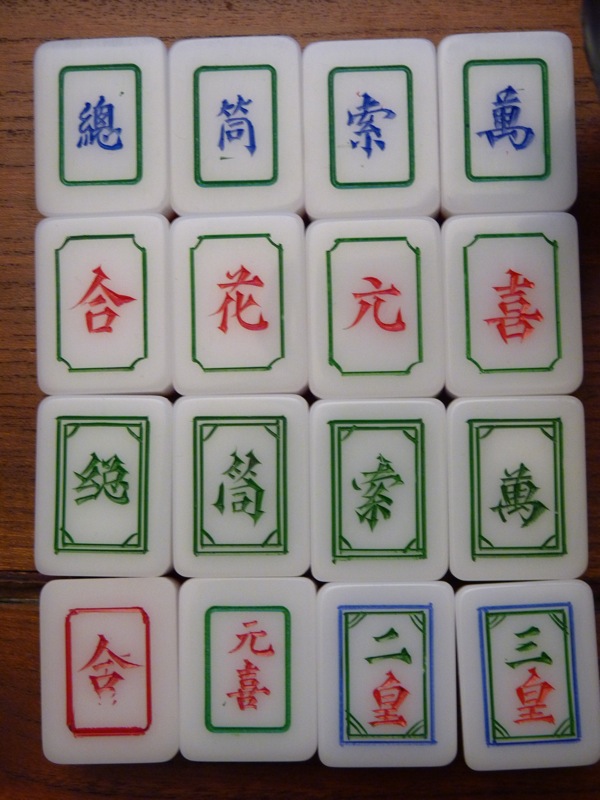
Extra tiles

Needing help with Chinese characters

Tags: blog, , , , 14 Comments »

Er…
So this is possibly quite silly, but the H and I need someone who can read Chinese. See, we bought ourselves a nice rice cooker from the local Chinatown. What we hadn’t planned for was that although it came with an English instruction manual, it doesn’t provide an explanation of the different settings in a language either of us speaks. There’s a row of white Chinese characters around the central LCD screen (which is meant to be the cooking modes), and a further set of five settings on the LCD screen itself (which is meant to be the rice type, if we read the instruction manual correctly). I have no idea if they’re traditional or simplified Chinese.

Pictures below after the cut. If anyone can provide us with translations, we’d be pretty grateful (it would avoid our messing up dinner by confusing congee, steam-cooking and standard rice cooking…)

EDIT: we’re pretty reasonably sure the white characters are the following (or some variant): regular, quick, small amount, cake, steam, soup, congee, casserole. We just don’t know which ones correspond to which…
Read More »