Baby bok choy in oyster sauce

Tags: cooking experiments, , , , , , No Comments »

Cheating a bit with this one:  I adapted it from Rasa Malaysia. The original recipe had a bit more water in the sauce and required draining the vegetables thoroughly; I’m afraid I could never quite manage that (unless maybe popping them in a salad spinner…), so I skip the water part and rely on a bit of the water from the blanched vegetables to dilute the sauce.

Served here with chả lụa and rice (a bit of a fusion dish since I don’t really think bok choy is much of an item in South Vietnam; but it’s way easier to find here than some of the more typical stuff).

Baby bok choy with chả lụa

Baby bok choy in oyster sauce
Author: 
Recipe type: Side
Cuisine: Chinese
Prep time: 
Cook time: 
Total time: 

Serves: 4
 

A quick and healthy side dish
Ingredients
  • 6 baby bok choy
  • 2 cloves garlic, chopped
  • 1 tablespoon oyster sauce
  • ¼ teaspoon oil
  • ½ teaspoon sugar
  • Dash of pepper

Instructions
  1. In a wok over moderate temperature, fry the garlic until it turns light golden brown. Tip in a bowl and set aside. (the garlic will continue cooking in the bowl for a bit, so it’s essential to get it from the wok before it looks cooked).
  2. Wash the bok choy, and separate the leaves. Cut in half lengthwise the leaves which look a bit thick (usually the first 2-3 outer layers). Blanch the bok choy in boiling water for 30-40s, until the leaves look slightly wilted (veggies should still be a bit crunchy at that point). Drain and reserve.
  3. During blanching time, quickly mix the ingredients for the sauce in the wok. Tip the vegetables into the wok and drench them in sauce, then top with the garlic.

Erm…

Tags: blog, fiction, , , , , , , 5 Comments »

Remember when I said selling two different stories to two different Year’s Best was a first for me? I spoke a little too soon…

Sean Wallace just let me know that Rich Horton wants to reprint “Scattered Along the River of Heaven” and “Heaven Under Earth” in his Year’s Best Science Fiction and Fantasy 2013. That’s four freaking different stories to three different Year’s Best anthologies…

*faints*

If you’ll excuse me, I think I’ll be off to do some massive squeeing….

As the Wheel Turns in Lightspeed Magazine

Tags: blog, fiction, free fiction, , , No Comments »

As the Wheel TurnsAs part of the promotion for the launch of John Joseph Adams’ EPIC anthology (more info here), you can now read my short story “As the Wheel Turns” (associated author interview is here). This is, er, another instance of a time machine story–written well over 4-5 years ago and in a style that I don’t think I could reproduce now, even if I tried. But hey, it got me into an anthology with Ursula Le Guin and Kate Elliott!

In case you’re wondering, I wrote this by drawing on the stories I read/was told as a child–it’s not strictly accurate historical China so much as a fairytale version of it, coupled with my misunderstanding a couple of things because I was very young when I heard said stories (and also the fact that Chinese culture != Vietnamese culture, though they of course share a bunch of common tropes/myths/etc.). But I still have a fondness for the story; it’s not every day you get to write a story with multiple reincarnations of the protagonist. Do tell me what you think of it.

(if you were at WFC, this is the story I read the first third from at the EPIC group reading–I know some people asked me if they could find it elsewhere, and I apologise for completely blanking on the fact that Lightspeed was going to reprint it…)

In the Tenth Court of Hell stands the Wheel of Rebirth.

Its spokes are of red lacquered wood; it creaks as demons pull it, dragging its load of souls back into the world.

And before the Wheel stands the Lady.

Every soul who goes to the Wheel must endure her gaze. Every soul must stop by her, and take from her pale hands the celadon cup, and drink.

The drink is herbs gathered from the surfaces of ponds, tears taken from the eyes of children, scales shed from old, wise dragons. To drink is to forget, for no soul can come back into the world remembering past lives, or the punishments meted out to it within the other Courts of Hell.

No soul.

Save one.

Read more.

On loss of language, colonisation and migration

Tags: blog, links, , , , , No Comments »

Two great articles, courtesy of automathic:
-Juliana Qian writes about being of Chinese descent in Australia. A lot of it is either uncomfortably familiar experience and/or strikes home quite accurately:

Our cultures are exotic, fashionable, fascinating and valuable when contained within or filtered through a white Western lens – then our cultures are glittering mines. But drawing from your own background is backward and predictable if you’re a person of colour. Sometimes white people try to sell me back my culture and I have to buy it. My China is as much the BBC version as it is the PRC one. There are things I want to eat but cannot cook.

-Rahel Aima on vernacular English:

Embedded within non-western English lies a parallel tension. The vernacular promises all the seductive freshness of exoticised difference, as well as the inherited anger of the Postcolonial Clever—the comfortably removed expat with a knowing gaze. There’s a certain expectation of kitsch, discernible authenticity and legitimacy, or at the very least, something to appropriate, please yaar? Or—something to awkwardly skirt out of respect to cultural relativism and because we are ostensibly beyond the myth of native English. Except then there’s also the orientalised yet unacknowledged elephant in the room: that the diasporic writer just might be the new bedfellow of cultural imperialism.

Author’s notes for “Heaven Under Earth”

Tags: author notes, blog, , 4 Comments »

“Heaven Under Earth” mostly started as a dystopia: I wanted to show a society in which women were so scarce that men had had to improvise around their lack. This involved quite a bit of handwavium (mostly a background biological weapon developed by neo-Confucians to keep women in their place, and which backfired when used in the field), none of which actually showed up in the story but was necessary to help me design it!

Read More »

Cultural appropriation

Tags: articles, blog, rant, , , , 17 Comments »

[Warning: this is me in ranty, pissed-off mood. I apologise for picking targets and basically offloading my anger on them, but I honestly feel I can't make you understand what I mean without pointing at specific bits. Many thanks to Rochita Loenen-Ruiz for reading this before it went live]

Apropos of nothing and just for the record: when people complain about cultural appropriation, they’re not all [1] saying that outsiders shouldn’t write cultures foreign to them. However, what I suspect they’re saying [2] is this: some outsiders (rather more than you think) will get cultures egregiously and disrespectfully *wrong*. That, even if a lot of (other outsider) people think that a certain book/story did a great job of introducing them to a fancy new culture, it doesn’t change the orientalist/racist clichés or simply the bad facts that are presented in said fiction.
And when I say bad facts I don’t mean niggly details that would require weeks of research: I mean really, really bad facts akin to calling everyone in a French novel “Dracula” because everyone knows Dracula is a typically French name. Facts that should have been a part of any basic research process, and that make the reader doubt the author really cared about the culture they were so “thoughtfully” depicting. Names. Food. Religion. That kind of thing.

You’ll think that this is a tiny minority; a 0.01% of writers who get things wrong and are rightly excoriated for it. Thing is… this happens WAY more often than you’d think. This is NOT a tiny minority. I’m not saying it’s a 99.99% of fiction either, but cultural appropriation is not a negligible or insubstantial phenomenon. A significant amount of fiction out there makes me doubt much thoughtful research (or much research at all!) was involved.

To take just one example: the last few stories set in China I have read [3]. One of them, set in historical China, mangled the historical timeline so badly I wasn’t even sure it was the real China, and inexplicably forgot to have any kind of ancestor worship, which is a bit like doing medieval France without Christianity. One of them, set in a futuristic China, used the timeworn tropes of Chinese being horrible to their own women (because, you know, Confucianism [4]) and had said women rescued by Westerners (because quite obviously those poor Asians can’t rescue themselves). And the last one, set in what purported to be Ancient China, had a concerted state-supported effort aimed at imprisoning, mistreating and killing dragons (we’ve been over this before, but Chinese/Vietnamese dragons are NOT evil, they’re Heavenly beings. This is a bit like having a historical medieval Europe where kings authorise the chasing and killing of angels. Possible, but a. you’re not going to get very far because angels are way more powerful than humans, and b. you’re not going to stave off the wrath of God for very long…) For bonus points, that story also had an evil character on a quest for immortality that he later renounced because he wanted redemption. Er. No. Quests for immortality are perfectly fine in Chinese thought (see Daoist immortals. That’s perfectly OK, and in fact deeply respected).

Again, I’m not Chinese. But Vietnamese culture has a heck of a lot of overlap with Chinese culture, and none of these feel remotely OK to me. In fact, they feel like Western thought grafted on top of what someone thought were the “cool bits” of Chinese culture. And, without exception, all of these had glowing reviews by people convinced that those were accurate and nice representations of Chinese culture. Newsflash: no, no, and no. When a writer is perpetuating horrible clichés in the course of their writing, when they’re propagating transparently false ideas of what it means to live in a place and/or a time period… This is cultural appropriation, and it’s bad–and whether said writer meant it or not doesn’t change the fact that they’ve egregiously mangled someone’s culture through lack of care. It’s the bit that makes a lot of people angry, and quite justifiably so. [5] It’s not the fact that writers take cultures that aren’t from their traditions that attract people’s ire; it’s the fact that the depiction of those cultures are badly inaccurate on mind-boggling levels.

(there’s an easy way to avoid this if you’re using a 21st-Century culture btw–grab someone from said culture and ask their opinion about the basic stuff in your story)

Anyway, that was my afternoon rant. Apologies again, and thanks for listening. If anybody wants to weigh on how they feel about the subject, I welcome thoughts and discussions!

(also, if any Chinese people are reading this and feel that any of the examples I used aren’t appropriate, I’d be quite happy to be corrected. I would have used Vietnamese culture, which is the one I’m most familiar with, but Vietnam hasn’t been the subject of quite so many books and stories and I didn’t really have enough examples for this…)


[1] Some of them are, and I understand and respect that feeling. Likely, the reason they don’t want outsiders writing about their culture is exactly what I’m going to outline in this post–too many people have been doing it badly, badly wrong.
[2] Again, not claiming to walk in people’s heads. Seen the feeling a lot on the internet though.
[3] I’m not Chinese, as is by now evident; and China itself is huge and multifaceted. However, Vietnamese and Chinese cultures have a lot of points of intersection, especially when we’re talking Ancient China and Ancient Vietnam, since the second was basically a colony of the first. And also, I can spot an Orientalist cliché when I see one.
[4] Not saying Confucianism didn’t do a lot of damage; however, you have to realise that you can’t base a description of modern China/Vietnam on mores that have gone out of fashion or been severely toned down in the 20th Century. Having China follow old-school Confucianism, again, is a bit like having Europe still follow the hard-core Christian mores of the Middle Ages. Er, no?
[5] I very probably committed bad mistakes in the Obsidian and Blood books (well, not “very probably”, I know at least two errors that I wish I could fix), though I did my best research-wise. I do hope none of them are on that egregious level of failure, but if they are, I apologise profusely. I was much less aware of that kind of issues when I wrote Servant, and it shows.

The Rule of Names

Tags: articles, blog, rant, , , 16 Comments »

(yes, I like Ursula Le Guin’s Earthsea. Sue me)

I was planning to do a longer and more detailed post, but time, once again, has got away from me (sigh, already so late on so many things. Clearly, I need a better juggling teacher). So here’s the shortened version…

There are few things that throw people out of your carefully researched novels faster than getting names wrong. I once opened a novel that had a French protagonist, and didn’t get past the first page because all the French names looked like they’d been fished out out of an internet baby list [1]. Names are one of the first contacts people have with your characters, but they’re a surprisingly common source of fail in fiction.

The main reason they’re a source of fail is because often, people assume that the same naming rules they’re familiar with will apply everywhere in the world. And that’s hardly the case, as countries and cultures can have vastly differing naming customs. For instance, we don’t have middle names in France and think it a very odd concept when it does crop up in American movies (and Vietnamese do have an intercalary name, but it doesn’t have the same function or characteristics as a US middle name).

Here are a handful of examples to demonstrate the common traps into which writers can fall: they shouldn’t be taken as actual knowledge, more like an indicative checklist that things that can vary across cultures. Also, not an exhaustive list, as I drew from those cultures I was at least vaguely familiar with, which were mostly Vietnam, France, and Russia–but already, you can see that names can follow very different customs!

Some errors I’ve seen in books (beyond the obvious ones of picking names that are ridiculous or don’t exist):

-Getting name order wrong (Chinese/Vietnamese last names come before the intercalary name and the first name: for instance, someone whose last name is Nguyen, intercalary name is Thi and first name is Hanh would be Nguyen Thi Hanh, not Hanh Thi Nguyen)

-Not understanding that you might have little choice for last names. In Vietnam, 99% of the population bears a total of 14 last names, which means you just can’t invent a Vietnamese last name if you feel like it! However, first names aren’t taken from an accepted list but rather chosen by the parents on the basis of words/concepts they like (there are rules/guidelines/usages, but I won’t go into them here), which means you can have extremely uncommon first names. A related one is Russia, where people have a patronymic name (derived from their father’s first name) and a family name–which means names have a very distinct structure.

-Not understanding what marriage does to last names (in a lot of cultures, women don’t actually change their name to match their husband’s)

-Getting diminutives wrong (a lot of cultures have different patterns than the usual Anglo one of shortening someone’s name by a few syllables to be more informal or more affectionate. See, for instance, Russian. Getting affectionate in Vietnamese mostly involves pronouns rather than diminutive forms of the names–OK, partially because Vietnamese first names are so short!)

-Conversely, not understanding how to address people formally. Using someone’s last name isn’t always the formal method to address them. In Vietnam, you use Mr./Mrs [2] + First Name to address someone formally.

I’m sure there are plenty more things to watch out for, but I’m only familiar with a handful of cultures… Anyone else have tidbits about how naming principles differ across cultures?


[1] Internet baby lists can be very dangerous, as they’re the first things that pop up when you’re looking for “names from xxx culture”, but are either badly compiled, or list all possible names without warning you if they’re popular or dorky choices (hint, for instance, don’t try calling your French female MC “Cunégonde” unless you want everyone laughing at her).
[2] “Mrs.” actually covers lots of different modes of address depending on how old the speaker is compared to you (“Grandmother”, “Aunt”, “Elder Sister”, “Younger Sister”, “Child”…), but this is very complicated and beyond the scope of this list!

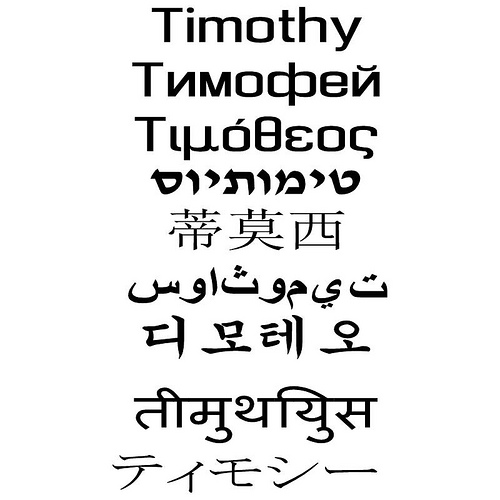
(picture credits: Timitrius on flickr, shared under a creative commons attribution share alike generic license)


Thit xot chua ngot va vai: sweet and sour pork with lychees

Tags: blog, cooking experiments, , , No Comments »

(Thịt xốt chua ngọt và vải)

OK, first off, the cautionary note: this is a loooong recipe, and I really mean it. The sauce itself is fairly quick to make (and can be made in advance and kept in the fridge for days); but it’s the marinating plus frying of the pork that’s really slow, as you have to do it in batches and paying attention all the time….

The traditional recipe is twice-fried: a first time on lower heat to cook the meat through, and a second time to make the batter crispy. You can do this if you wish; I admit that after 2 hours of cooking and prepping, I wasn’t really in the mood for an extra batch of meat frying… I’m sure this isn’t authentic, but heck, it tastes good and it was nice, so…

(you can also omit the egg white; I put it in because I never what to do with a lonely egg white, but the recipe only called for an egg yolk)

This is one of the reasons I keep ketchup in my fridge (the other is xá xíu ). Otherwise, I actually hardly ever touch the thing!

Thit xot chua ngot va vai: sweet and sour pork with lychees
Author: 
Recipe type: Main
Prep time: 
Cook time: 
Total time: 

Serves: 4
 

A nice sweet and rich dish
Ingredients
  • 1 pound pork shoulder or pork loin, cubed
  • ¼ cup cornstarch mixed with ¼ cup flour for the batter
  • ½ teaspoon salt
  • 2 teaspoons light soy sauce
  • 1 tablespoon sesame oil
  • 1 tablespoon cornstarch dissolved in 1 tablespoon water
  • 1 egg, beaten
  • 5 tablespoons sugar
  • ½ teaspoon salt
  • 4 tablespoons rice vinegar
  • 3 tablespoons light soy sauce
  • 2 tablespoons rice wine
  • 3 tablespoons ketchup
  • 1 large clove garlic, lightly crushed and peeled
  • 1 tablespoon cornstarch dissolved in 3 tablespoons water
  • 1 tablespoon sesame oil
  • ½ cup water
  • 1 cup canned lychees, cut in halves

Instructions
  1. Cube the meat, then place in a bowl. Mix the sesame oil with the cornstarch-water mixture. Sprinkle salt and soy sauce all over the meat, then add the oil-cornstarch-water mixture. Add the beaten egg, mix well. Marinate for at least 30 minutes.
  2. Make the sauce: mix the sugar, salt, rice vinegar, light soy sauce, rice wine and ketchup. In a heavy frying pan or skillet, put a little oil on high heat, then the garlic. Wait until fragrant, then add the sauce mixture previously put together. Slowly stir with a spatula until the liquid comes to a boil. Set heat to low, continue stirring, and add the cornstarch mixture until the thickening begins. Then add the water little by little, still stirring, until the sauce is smooth and bubbly. Turn off the heat.
  3. Fry the meat: put a little oil wok or frying pan on high heat. Wait until it’s hot (bubbles congregating rapidly around wooden chopsticks laid in the pan). Drag the meat in the flour-cornstarch mixture, and put it in the pan. Fry in batches until the meat is cooked, and the coating is crisp and golden. Drain on paper towels and set aside.
  4. Assembly: bring the sauce back to a simmer over low heat. If you can, remove the garlic. Turn back to medium heat, scatter the lychees in the sauce and make quick flipping motions with chopsticks or spatula until the fruit are coated with sauce. Turn heat high; scatter the fried meat in the sauce, and tumble it very quickly until it’s coated with sauce as well. Turn off heat, and serve.

Notes
This is a very rich dish, and it’s worth serving it with something fresh (I usually slice cucumbers to go with it, or some sort of salad, in addition to the rice). Pineapple, kumquats, or any kind of sweet fruit with a tang would also work nicely (the original recipes was with pineapples, but don’t restrain yourself if you only happen to have rambutans…).


Help with deciphering mah jong tiles?

Tags: blog, , , , , , 6 Comments »

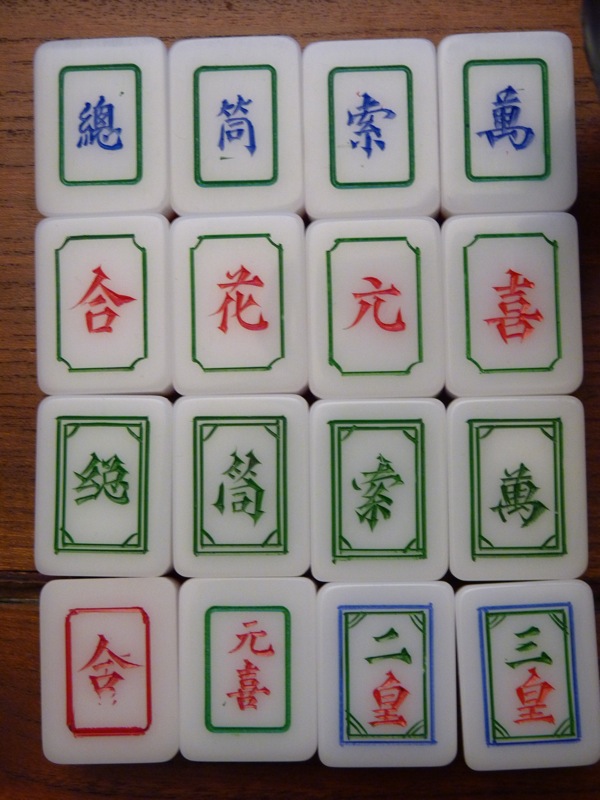
So, here’s the bonus question: our mah-jong game (a gift from my grandma, bought in Vietnam) came with 16 extra tiles. We have 152 normal tiles (4 copies of the three sets+dragons+winds, and 4 seasons and 4 flowers). From googling things up on the next, we think that the extra tiles we can’t identify are Vietnamese jokers (this site and this site both describe the Vietnamese mah jong variant as having 16 jokers, which can replace a variety of tiles, from the “Emperor” who can replace pretty much anything, to the “Dragon Lady” who can replace any dragon, and so on). However, to start with, those two websites don’t agree on which tile is which! Also, neither of them has the full set of our tiles…

On the off-chance that someone would know either Vietnamese mahjong, or how to read Chinese characters–do those tiles below mean anything to you? (bear in mind it’s a Vietnamese mah jong game, so the Chinese characters are approximative, to say the least…)

And bonus question: anyone have the Vietnamese rules of the game? Sloperama mentions that there are only 19 ways of “going out”, which should correspond to the special hands in Classical Chinese mah jong, but the Classical Chinese rules I can find on the net pretty much fail at having 19 special hands…

ETA: following the find of a Vietnamese set of rules (in Vietnamese *sob*) I am pretty reasonably sure that the two topmost ranks are as follows, from left to right:
Blue: tile which replaces any tile, tile which replaces circles, tile which replaces bamboos, tile which replaces cracks
Red: tile which replaces any ordinary tile (bamboo, circles, cracks), “Great Flower’ aka tile which replaces any flower, tile which replaces any Dragon, tile which replaces any Wind
I have no idea of their names in English.

Extra tiles

“As the Wheel Turns” podcast

Tags: free fiction, free stuff, podcast, , No Comments »

You can now listen to the podcast of my pseudo-Chinese story “As the Wheel Turns” over at issue 9 of Dark Fiction Magazine (where I am in the stellar company of Juliet McKenna, James Barclay Andrew Reid and Kev Clark).

Click here for the podcast. Thanks to Sharon Ring, Kate Sherrod and the rest of the Dark Fiction Magazine team!